

If you follow life sciences research, you’ve probably heard the buzz around extracellular vesicles...
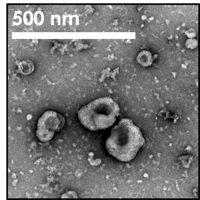
Transmission electron microscopy (TEM) has a fundamental, yet quiet, role in EV research. We use it to prove to ourselves (and reviewers) that our purified EV samples really contain EVs. At least, that’s what I did during my PhD in 2018, when I jumped headfirst into EV research. EVs appear as rounded, sometimes cup-shaped, particles ranging anywhere between ~20 – 1000 nm. But I noticed something odd about the way EVs were identified by TEM in papers. Sometimes, a TEM image would contain one single zoomed-in particle. Other times, the image would have so many other particles in the field of view, I wondered how the authors managed to distinguish the EVs from the “other stuff”. It certainly takes a trained eye to pick EVs out of a complex matrix!
Because there is no standard EV isolation technique and negative stain TEM preps can introduce artefacts, it can be difficult to ascertain the content of the images. I’ve imaged and analyzed hundreds and hundreds of TEM images, and I still get puzzled from time to time. But I have also learned a lot of interesting things along the way. Here, I provide a brief educational overview of TEM and discuss some of the specimen we may see in our images and how to decipher them.
Basic Principles of TEM
A transmission electron microscope contains four main components: an electron source, a vacuum column, the electronics, and a detection system. Negative stain transmission electron microscopy requires an electron dense contrast agent, which stains the sample and creates varying levels of electron scattering. Electrons that pass through the sample are picked up by the detector and appear “light”, while electrons that are scattered from the sample create areas of darkness, or shadows. The resulting image reveals highly resolved structures based on how the contrast agent coats the surface. To stain EVs, one “simply” dips an EM grid into sample, water (or rinse buffer), and then a contrast agent, like uranyl acetate. Once dried, the grid is loaded into an electron microscope and imaged.
Brief history of TEM
TEM wasn’t always so streamlined and straightforward. The first electron microscope was conceptualized and created in 1931 by two German scientists, Ernst Ruska and Max Knoll1. The sample images were blurry and difficult to interpret. In the following decades, commercialization of the electron microscope led to massive improvements in its internal components, allowing for better resolution and focus. The first extracellular vesicles imaged via TEM coincidentally appeared in the 1940s, at the advent of electron microscopy, simply as membrane debris. Peter Wolf famously described EVs as “platelet dust” in 1967—their true nature overshadowed by other discoveries2. It wasn’t until the 1970s and 1980s when extracellular vesicles were finally identified as, well, vesicles. Since then, scientists have been endeavoring to understand their role in biology.
EV Characteristics
The composition of a nanoparticle changes how it shows up in TEM. The most definitive way to identify an EV in TEM is to use gold-conjugated antibodies to physically tag them. However, this is a difficult and tedious process and generally intractable. But we can use the characteristics of EVs, such as the membrane, size, and source to understand their appearance in negative stain TEM images.
Membrane
EVs are notably fragile. The sample preparation often induces membrane dehydration and collapse, which gives EVs their famous cup-shape morphology. There are several factors that likely contribute to this appearance. EVs have a lipid bilayer that surrounds aqueous lumen, and several groups have reported the presence of channels, including aquaporins, that decorate the surface. Membrane composition and topology may cause EVs to be more susceptible to artefactual morphological changes and more pooling of stain on top of and around the EV. Storage is important. Based on my own experiences, freeze-thaws can induce membrane rupture and EV destruction (Figure 1). Additionally, coating EVs with BSA can cause them to take on a fuzzier, darker appearance (Figure 2).
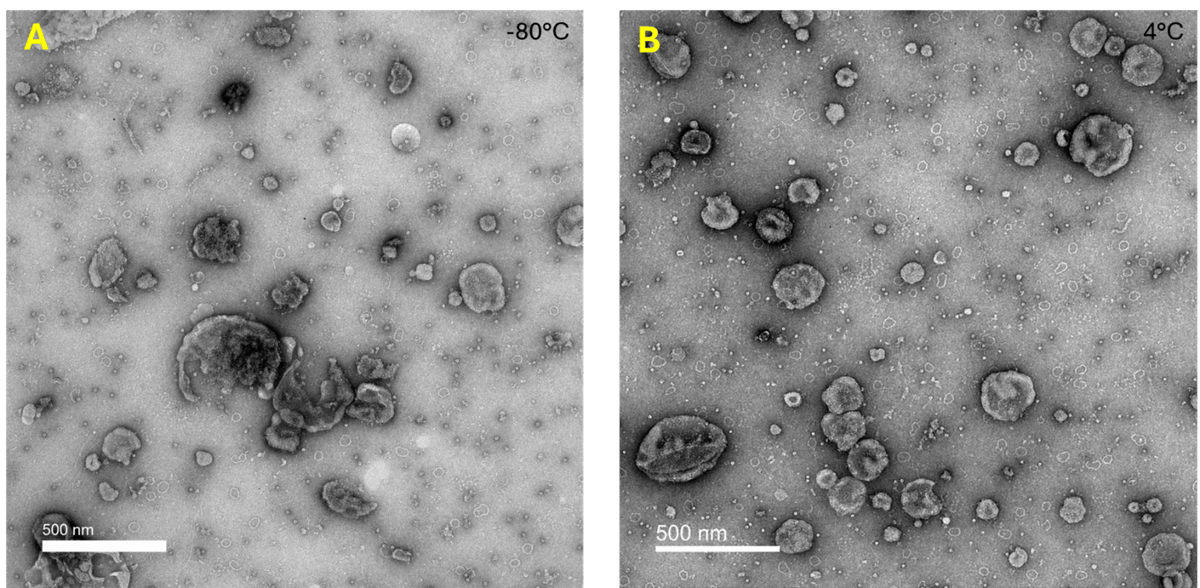
Figure 1: EVs from HEK293T cells were isolated via ultracentrifugation and resuspended in 1X PBS. The sample prep was either (A) stored at -80°C or (B) stored at 4°C and then stained and imaged. Ruptured membranes can be observed in greater frequency for EVs that received a freeze-thaw cycle.
Size
The smallest size for an EV may be as low as 20-30 nm, although there is no consensus at this time. EVs can be up to several microns in size, but those sizes tend to be rarer in standard EV preps, which typically involve a large vesicle depletion or debris clarification step. In TEM, all sizes should be considered fair game if we are to define the EV size range as anywhere between ~20 – 1000 nm, so it is important to use other clues to figure out if the particle is an EV or not.
Source
Composition of the biofluid changes the way EVs appear in TEM. There are different matrix effects in plasma, cell culture, cerebrospinal fluid, bacteria, plants, etc. that influence the flavor of the image. Cell culture-derived EVs, for example, are artificially created by some combination of adding or subtracting serum, growing on plastic or in suspension with mechanical agitation. Plasma, on the other hand, is always chock full of lipoproteins and albumin. How “pure” the EV isolation will affect how EVs appear in a field of view with contaminants.
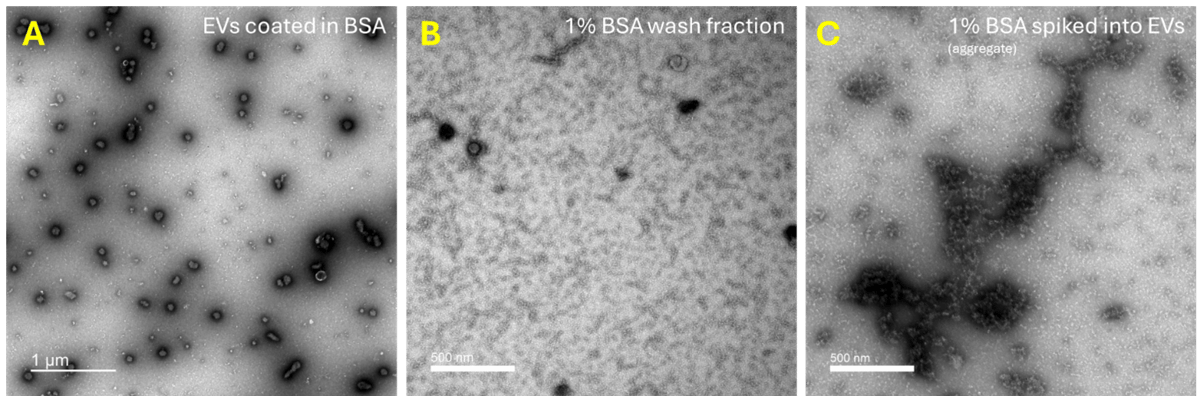
Figure 2: EVs from HEK293T cells were isolated via ultracentrifugation and resuspended in 1X PBS. The sample prep was spiked with BSA and washed, producing two fractions: (A) EVs coated with BSA and (B) the wash fraction. (C) The EVs were spiked with 1% BSA and a BSA aggregate was specifically imaged for the purpose of showing the morphology of aggregated BSA.
Contaminants and Their Characteristics
An important key to identifying an EV in a sample is to understand and identify the contaminants. This is where things get interesting. Samples can contain many different types of non-EV species, including lipoproteins, albumin, nucleic acids, and non-membranous nanoparticles. It is difficult to assess with certainty what is what, but there are clues that provide indirect evidence of their identity. Take these explanations into careful consideration, as they do contain speculation.
Lipoproteins
Lipoproteins are nanoparticles that have a phospholipid shell surrounding a triglyceride and cholesterol core. The shell is decorated with a specific class of proteins called apolipoproteins. Unlike EVs, lipoproteins have a lipid-rich center, which is likely responsible for them showing up as very light, high contrast particles (Figure 3). In negative stain TEM prep, lipoproteins appear to be more resistant to membrane collapse and are therefore likely to be more rounded with a crisp outer edge3. Lipoproteins are also more likely to appear as rouleaux, or stacks, than EVs. Unfortunately, the size range of lipoproteins overlaps substantially with EVs, so it takes a very sharp eye to discern likely-lipoproteins from likely-EVs.

Figure 3: (A) EVs were isolated from conditioned media containing 1% EV-depleted fetal bovine serum (FBS) via tangential flow filtration (TFF) with a 500kDa MWCO. Lipoproteins were retained and can be seen in numerous quantities. (B) EVs were isolated from plasma via size exclusion chromatography (SEC) by pooling and concentrating the EV fractions (and one overlapping lipoprotein fraction). Lipoproteins appear in numerous quantity as very bright spheres. (C) EVs were isolated from plasma via SEC and the fraction with the highest CD9 content was stained and imaged. The yellow circle shows EVs. Red circles highlight lipoproteins.
Albumin and Other Protein
Albumin is one of the most common contaminating proteins to appear in a sample prep. In a directed study, I spiked 1% BSA into a purified EV prep and compared it with a control. In another study, my colleague coated EVs with BSA and washed off the excess BSA. I stained both the EV fraction and wash fraction. EVs coated with BSA take on a fuzzier, darker appearance. BSA by itself appears light grey and very flat; aggregated BSA appears dark and fuzzy (Figure 2). In typical EV preps, albumin, and perhaps other proteins, can appear as either chunky aggregates or as a light fuzzy background stain.

Figure 4: (A) an EV sample prep from conditioned media shows bright white, flat looking membranous material intermixed with EVs. (B) an EV sample prep contains EVs and: 1. lightly stained circular loops that resemble nucleic acid, 2. donut-shaped nanoparticles that suspiciously look like ferritin, and 3. protein aggregates.
Another species that appears abundantly in cell culture-derived EV preps are ~13-18 nm spherical, donut shaped complexes (Figure 4B). The size and shape, with the dark core, invokes ferritin or a related protein architecture4,5. I am confident that these particles are a particular type of protein or protein complex at the very least.
Nucleic Acids (RNA, DNA, Plasmids)
Perhaps the least talked about contaminants are extracellular nucleic acids. In TEM, they should appear as stringy, tiny, and lightly stained6. In my cell culture-derived EV prep, the stringy, circular loops seem to be nucleic acid in nature (Figure 4B). If you look carefully, you can even find a long stringy object next to an EV. I have spotted loops in other EV papers and suspect they are extracellular RNA expelled into cell culture media7 (they’re everywhere!).
Concluding Remarks
TEM is a remarkable technology. We can gather a lot of information from such a small field of view. As we continue to develop and refine EV isolation techniques, we will be able to use TEM in conjunction with orthogonal techniques (such as super resolution fluorescence microscopy) to understand the nature of EVs and their matrix.
Thank you to Dr. Guillaume Castillon for reviewing and providing feedback for this content and to the Electron Microscopy Core at UC San Diego for the acquisition of the TEM images.
References
- 75 Years of Innovation: The world’s first commercial Transmission Electron Microscope (TEM). SRI, URL: https://www.sri.com/press/story/75-years-of-innovation-the-worlds-first-commercial-transmission-electron-microscope-tem/
- P Wolf, The Nature and Significance of Platelet Products in Human Plasma, Journal of British Haematology, 1967. DOI: 10.1111/j.1365-2141.1967.tb08741.x
- L Zhang et al., Morphology and structure of lipoproteins revealed by an optimized negative-staining protocol of electron microscopy, Journal of Lipid Research, 2011. DOI: 10.1194/jlr.D010959
- C Quintana, J.M. Cowley, and C Marhic, Electron nanodiffraction and high-resolution electron microscopy studies of the structure and composition of physiological and pathological ferritin, Journal of Structural Biology, 2004. DOI: 10.1016/j.jsb.2004.03.001
- M Truman-Rosentsvit et al., Ferritin is secreted via 2 distinct nonclassical vesicular pathways, Red Cells, Iron, and Erythropoeiesis, 2018. DOI: 10.1182/blood-2017-02-768580
- B Cayrol et al., Auto-assembly of E. coli DsrA small noncoding RNA: Molecular characteristics and functional consequences, 2009. DOI: 10.4161/rna.6.4.8949
- A Hoshino et al., Extracellular Vesicle and Particle Biomarkers Define Multiple Human Cancers, Cell, 2020. DOI: 10.1016/j.cell.2020.07.009
.jpg?width=50&name=Janet%20Headshot%20(1).jpg)